Business Waste Removal Barking — Recycling and Sustainability
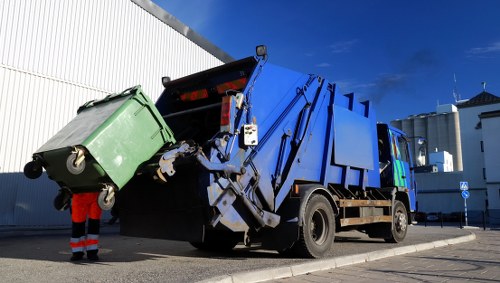 Business Waste Removal Barking is committed to creating an eco-friendly waste disposal area for local companies and a truly sustainable rubbish area across the borough. Our approach focuses on reducing landfill, maximising reuse and recycling, and helping Barking businesses meet both corporate and local authority targets. We combine practical collection services with community partnerships and low-carbon transport to reduce environmental impact while keeping operations simple for busy sites.
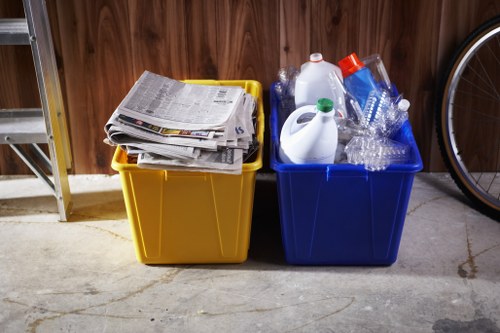
We work with commercial clients across retail, hospitality, light industry and offices to tailor recycling streams. Barking business waste removal plans usually include separated collections for paper and card, glass, rigid plastics, cans, food waste and mixed dry recycling. Many boroughs now favour a source-separated model or closely monitored co-mingled collections with strong sorting at transfer facilities — our system aligns with both approaches to support local authority policies and improve overall diversion rates.
Targets and measurable goals
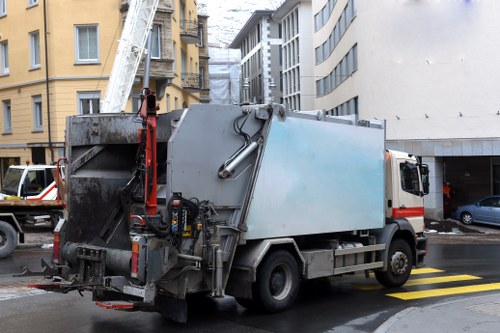
We have set a clear recycling percentage target: a borough-focused aim of 65% recycling and reuse by 2030 for our commercial customers. To reach this we use a combination of weekly performance reporting, audits of waste streams, and staff training to increase capture rates for high-value recyclables and food waste. Progress is tracked by weight and by the number of re-used items donated to community partners.
Local transfer stations are central to delivering an effective eco-friendly waste disposal area. We consolidate collections at authorised transfer depots and civic amenity sites in east London, where materials are sorted, baled and sent to specialised processors. By using nearby transfer hubs we cut vehicle miles and speed up recycling throughput, which supports a lower-carbon circular economy for the borough.
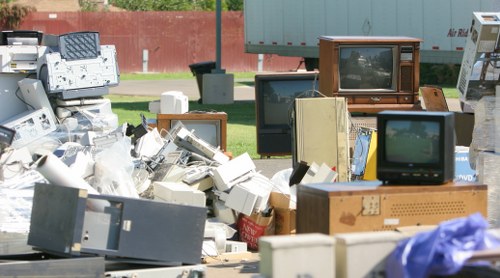
We also handle more complex streams: WEEE (electricals), bulky furniture for reuse, construction and demolition sorting for separate aggregates and wood recycling, and secure document destruction with paper recycling. Each stream is recorded so businesses can report on sustainability metrics and comply with environmental reporting obligations.
Partnerships with charities and local reuse networks
Partnerships are a key part of our sustainable rubbish area strategy. We collaborate with local charities and social enterprises to rehome usable items: surplus furniture, office equipment, textiles and working appliances are diverted to community projects, training organisations and affordable reuse shops. These partnerships deliver social value and reduce the carbon footprint associated with producing new goods.
Our charity collaborations also help tackle waste from hospitality and retail: edible surplus can be redirected to food redistribution charities; textiles and clothing are sent to social recycling schemes; and IT equipment is refurbished for community access programmes. We maintain clear protocols for donation, ensuring items meet health and safety standards before handover.
To complement physical reuse, we operate waste audits and staff engagement programmes to change behaviour at source. Simple interventions like correct bin signage, on-site segregation points and scheduled audits increase recycling capture and reduce contamination — crucial elements for a successful sustainable rubbish area across Barking and surrounding wards.
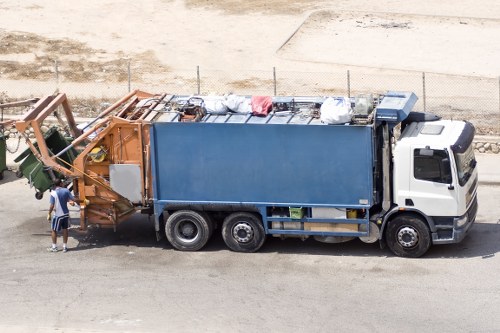
Operationally, our fleet supports green logistics. Low-carbon vans and electric vehicles are integrated across local routes to minimise emissions, and route optimisation software reduces idle time and fuel use. When electric vans aren't yet feasible for heavier loads, we use hybrid and Euro 6 vehicles to keep pollutant levels down while maintaining reliable service for businesses.
Services that support local authority plans
We align our services with the London boroughs' approach to waste separation and the wider municipal strategy. That can mean supporting separate food waste collections for commercial kitchens, ensuring glass is kept separate to preserve quality for re-melting, or collecting high-grade cardboard for pulping. These targeted activities raise the value of recycled material and lower the likelihood of rejection at processors.
How we measure success
Success is measured by recycling rates, reduction in residual waste, volume of items reused and the reduction of transport-related emissions. Regular reporting includes weights per stream, percentage progress toward the 65% recycling target, and carbon-equivalent savings from using low-carbon vans and donating items for reuse. Our aim is to create a replicable model for a truly eco-friendly waste disposal area that other commercial operators can adopt.
By combining targeted collections, local transfer station use, charity partnerships, vehicle decarbonisation and ongoing education, Business Waste Removal Barking helps businesses transform waste into value. Together we can build a resilient, sustainable rubbish area in Barking that benefits the environment, the community and the bottom line.
